
Items
-
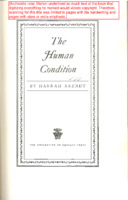 Arendt, Hannah. The human condition (Chicago : University of Chicago Press, c1958). Thomas Merton's Marginalia Collection (marginalia only partially digitized, see note below). Note: Merton underlined so much text of the book that digitizing everything he marked would violate copyright. Therefore, scanning for this title was limited to pages with his handwriting and pages with stars or extra emphasis.
 -
 Ardrey, Robert. African genesis (New York, Dell Pub. Co., 1963 [c1961]). Thomas Merton's Marginalia Collection.
 -
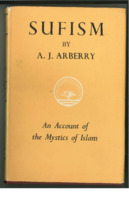 Arberry, A.J. Sufism: an account of the mystics of Islam (London, Allen & Unwin [1956]). Thomas Merton's Marginalia Collection. Archivist's note: additional marginalia discovered on pages 50-51 and added to scanned file 22 July 2024.
 -
 Antoninus, Brother (William Everson). The Crooked Lines of God: Poems 1949-1954 ([Detroit] University of Detroit Press, 1959). Thomas Merton's Marginalia Collection.
 -
 Anselm, Saint, 1033-1109 - Letters of St. Anselm, Archbishop of Canterbury. Thomas Merton's Marginalia Collection.
 -
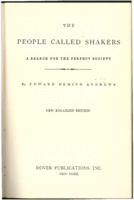 Andrews, Edward Deming. The People Called Shakers (New York, Dover Publications [1963]). Thomas Merton's Marginalia Collection.
 -
 Andrews, Edward Deming; and Faith Andrews; with photographs by William F. Winter. Shaker furniture, the craftsmanship of an American communal sect (New York, Dover Publications, 1950 [c1937]). Thomas Merton's Marginalia Collection.
 -
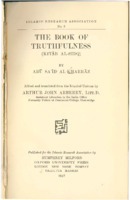 Al-Kharraz, Abu Sa'id Ahmad ibn 'Isa. The book of truthfulness (Kitab al-sidq) by Abu Sa'id al- Kharraz; edited and translated from the Istanbul unicum by Arthur John Arberry (London ; New York : Oxford University Press, 1937). Thomas Merton's Marginalia Collection.
 -
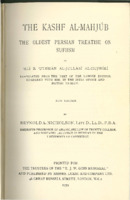 Ali ibn Usman, al-Jullabi al-Hujwiri - The Kashf al-Mahjúb; the oldest Persian treatise on sufiism by Alí B. Uthmán al-Jullábi al-Hujwírí. Translated from the text of the Lahore edition, compared with mss. in the India office and British Museum by Reynold A. Nicholson (London, Printed for the trustees of the E. J. W. Gibb Memorial and published by Luzac & Co., 1959). Thomas Merton's Marginalia Collection.
 -
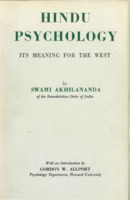 Akhilananda, Swami. Hindu psychology: its meaning for the west (London, Routledge and Kegan Paul [©1948]). Thomas Merton's Marginalia Collection.